
Missed calls, longer wait times, and a support team already stretched to capacity are common signs that a business needs additional help. The search for a solution often leads to two very different answers: Use an AI voice agent or hire a virtual assistant.
Both are positioned as the fix, but few resources explain which option is a better fit for a given business. This article addresses that gap directly.
This isn’t the broader AI vs human support in customer service debate you’ve probably read about elsewhere; that’s a more abstract comparison of automation against human judgment in general, separate from the question of which option actually solves your specific problem. This article stays narrower and more actionable. We assume you already know you need help. You just need to identify which kind is the right fit for your business.
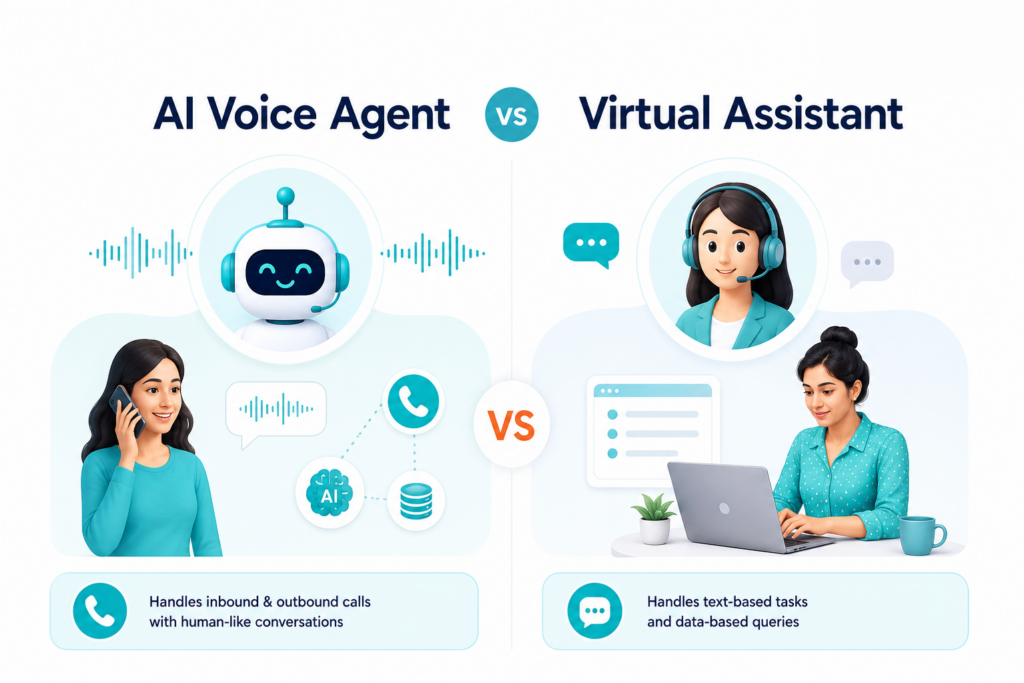
A visual comparison of AI voice agents and virtual assistants, highlighting how both solutions support customer service operations.
Line them up side by side, and it all gets clearer:
| Factors | AI Voice Agent | Virtual Assistant |
|---|---|---|
| What it is | Software that answers and holds phone conversations | A real person working remotely for your business |
| Handles | Calls only | Calls, emails, scheduling, admin, research, and more |
| Availability | 24/7, every day | Set hours, usually business hours or agreed-upon shifts |
| Setup time | A few days | A few days to a couple of weeks, depending on the role |
| Cost model | Per-minute or flat subscription | Hourly or monthly rate |
| Best suited for | High call volume, fast and consistent answers | Judgment calls and tasks beyond just phone support |
An AI voice agent works by combining speech recognition with intent detection, picking up what a caller actually wants and responding or taking action in real time, and that mechanic is what makes it fundamentally different from scripted IVR systems; the deeper technical breakdown lives in our guide to AI voice agents for customer service and support.
Virtual support runs on a different logic altogether, since what virtual customer service actually is comes down to a real person handling requests behind the scenes, reading context, and making judgment calls an AI still can’t, which is exactly the kind of gap this blog gets into next.
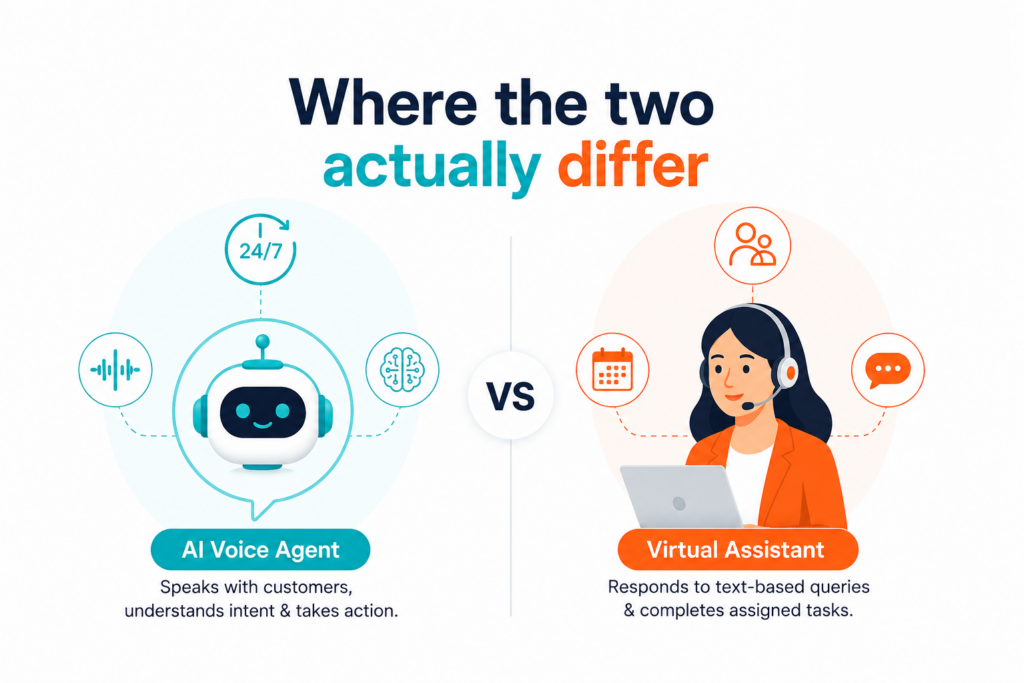
Where AI voice agents and virtual assistants actually differ
Scope of work
An AI voice agent is built for one function: answering the phone and holding a conversation that sounds natural. It does not coordinate a shipping delay with a warehouse, draft a follow-up email, or manage a calendar between calls.
A virtual assistant typically covers more than that. A virtual assistant can take on various tasks based on their role. They can manage your inbox, follow up on leads, and schedule appointments. They can also conduct research and handle small tasks that pile up during the day.
This broader scope is usually one of the reasons why you should hire a virtual assistant in the first place: not phone support alone, but everything that comes with a broader, more flexible hire.
If the core issue is missed calls specifically, an AI agent addresses that directly. If the issue involves several smaller tasks coming up at once, with calls being only one part of it, a virtual assistant tends to cover more of it in a single hire.
Time to deploy
AI voice agents can be set up quickly. Once a provider knows the business, its usual questions, and its tone, an agent can start taking calls in just a few days. No interviews are needed.
Hiring a virtual assistant takes time. You need to find the right candidate, evaluate them, and give them time to learn the business, just like any new team member. This is not a lengthy process, but it is not immediate either.
For businesses where speed is the deciding factor, this distinction often settles the decision on its own.
Cost structure
AI voice agents usually charge by the minute or have a flat monthly fee. This means costs are based on usage, not a person’s working hours. Virtual assistants are generally paid hourly or on a monthly basis, similar to any other remote hire.
On a pure cost-per-call basis, the best AI agents for customer support and service tend to be more economical, particularly as call volume increases. The cost for virtual assistance is mostly stable, regardless of daily call volume. Still, they do have a natural capacity limit. You’ll see a more detailed cost comparison that follows later in this blog.
Call volume capacity
This is where the difference becomes more apparent. A virtual assistant is one individual and can only manage one call at a time; once their schedule is full, capacity is reached.
An AI voice agent does not have that constraint. Whether ten calls arrive simultaneously or one, all are handled without delay. This is a large part of why voice AI adoption has grown quickly.
Recent industry research found voice AI handling 19% of inbound contact-center volume in 2026, up from just 6% in 2024, with businesses turning to AI in call centers to avoid hiring more staff every time call volume increases.
This approach helps them avoid hiring more staff whenever call volume increases. When missed calls during peak periods are the primary concern, this factor usually outweighs cost.
Judgment versus consistency
AI delivers a level of consistency that is difficult to replicate with people, but it operates within defined limits. It reliably manages conversation structure. If a request is outside familiar patterns, its response is limited to what it can handle.
For example, an AI voice agent handling a routine appointment reschedule manages the date and time changes without issue, but if the same caller is frustrated about a recurring problem and wants to vent before getting to the actual request, the agent can respond too literally to the surface-level ask and miss the frustration entirely, a moment a human would pick up on immediately and de-escalate.
The strongest AI agents in customer service and support continue to improve in this area, but a ceiling on improvisation still exists.
A virtual assistant understands context. It can make decisions and handle unique requests. It does this without a set script. This flexibility is very important. It matters more when customers often raise issues that don’t fit standard categories.
Where AI voice agents and virtual assistants work together
AI voice agents and virtual assistants have key differences. A better question is what happens when a business uses both. Many see it as an either-or choice, but each solves different issues. As a result, many businesses find they need both solutions.
An AI voice agent fixes the volume issue. It answers every call, whether it’s the third or the thirtieth of the day. The questions it knows are answered consistently. It doesn’t manage tasks after a call. This includes updating records, following up on leads, rescheduling missed appointments, or handling special requests.
A virtual assistant adds value by handling tasks that an AI voice agent can’t do. Instead of supporting AI on complex calls, it focuses on the operational work.
Used together, one ensures no call goes unanswered, and the other ensures the business keeps moving between calls. When a call does need to be handed off to a person, whether that’s the virtual assistant or another team member, the transition works best when the full transcript and context transfer along with it so the customer isn’t asked to repeat themselves.
Which one is the best fit for your business?
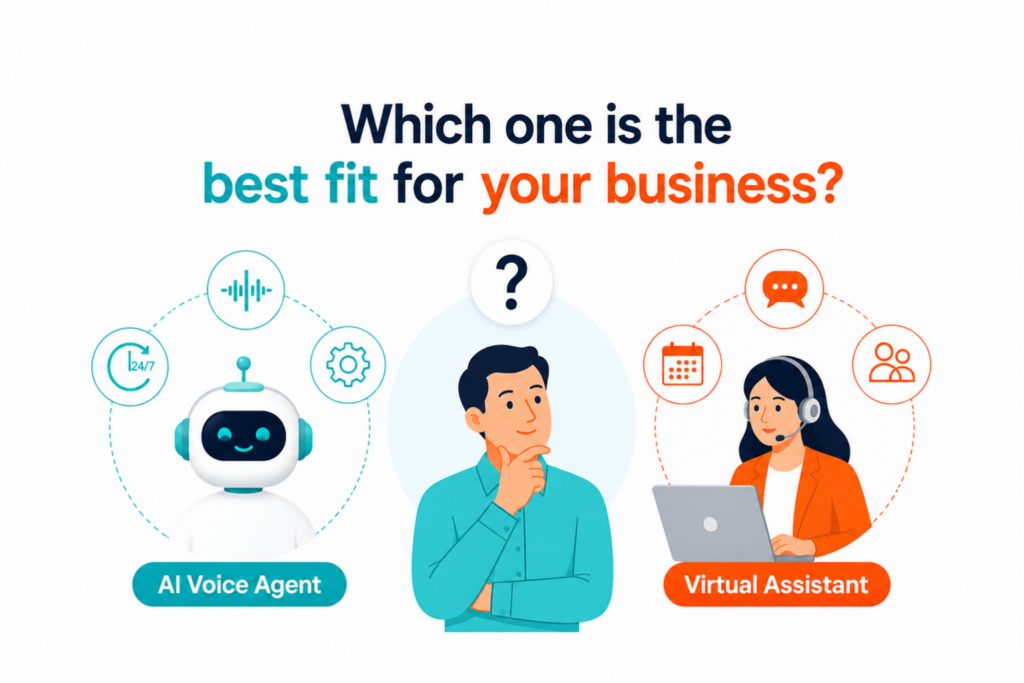
A practical way to approach the decision:
An AI voice agent is the right fit when
The main need is to answer calls. The questions are quite predictable. Call volume can change unexpectedly, and you need coverage outside business hours without the cost of a night shift.
A virtual assistant is the right fit when
The work goes beyond phone calls. You often need to make decisions based on judgment. Support is also needed for admin and operational tasks during customer conversations.
Both are the right fit when
The business is growing fast. Call volume varies, and someone needs to focus on follow-through. This combination is common among businesses that outgrow relying on a single solution.
For those considering outsourcing rather than a direct hire, it’s worth comparing what the best virtual assistant companies typically charge and what’s included before making a decision.
Cost comparison between an AI voice agent and a virtual assistant
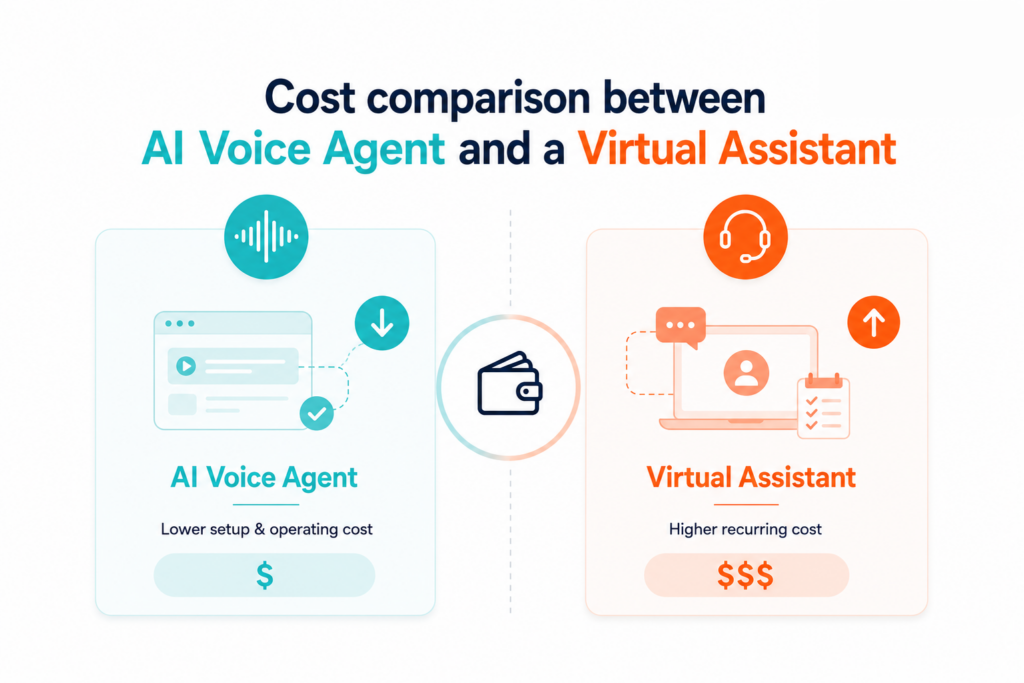
A cost comparison infographic showing the differences between AI voice agents and virtual assistants for business operations.
Concrete figures are more useful than general estimates, so here is a realistic sense of what each option typically costs on a monthly basis.
AI voice agents generally range from $0.07 to $0.49 per minute, depending on the provider and feature set, or a flat monthly subscription that adjusts with call volume.
Virtual assistants typically charge an hourly or monthly retainer fee, and the cost will depend on how much work is involved. The role can include everything from virtual assistant services such as administrative support, customer service, bookkeeping, and project management. A virtual assistant handling calls, emails, and administrative work will be more expensive than one performing a single, narrow task.
At higher call volumes, AI voice agents typically cost 60 to 80% less per interaction than staffing the equivalent human coverage, but cost shouldn’t be the deciding factor on its own.
As per Gartner’s customer service costs insight, self-service costs roughly $1.84 per contact, against $13.50 for agent-assisted support.
McKinsey’s contact center crossroads research has found similar results, with AI agents cutting cost per call by up to 50% in some deployments. The exact number will shift by provider and call complexity, but the direction is consistent.
AI voice agent vs virtual assistant: How AM2PM Support combines both
When comparing an AI voice agent vs a virtual assistant, the right mix of an AI voice agent and a virtual assistant depends on what a business actually needs day to day, not on which option is trending. That’s exactly why good customer service is so important for your business: choosing what keeps customers satisfied, not just what’s popular.
That’s why AM2PM Support offers both: an AI voice agent for calls that need fast, consistent answers, and a dedicated virtual assistant for the parts of the business that need human judgment. Book a free call with AM2PM Support, and we’ll help you find the right combination for your business.
Frequently asked questions: AI voice agent vs virtual assistant for customer support
What’s the difference between an AI agent and an AI assistant?
In everyday use, the two terms often overlap, but “AI agent” typically refers to software that can take independent action, such as completing a task or handling a full conversation, while “AI assistant” more often describes a tool that helps a person complete work rather than fully replacing that step.
Can an AI voice agent and a virtual assistant work together?
Yes, and this is how most growing businesses end up structuring their support. The AI voice agent handles the drudgery of repetitive, routine calls, and the virtual assistant handles the follow-through often required by those calls, such as updating records or rescheduling missed appointments.
Is an AI voice agent more cost-effective than hiring a virtual assistant?
AI pricing is mostly usage-based, not based on the number of hours a person works, especially with higher call volumes. When you need lower volumes, the price difference between the two drops quite a bit, and the choice of which one to use is often a matter of what kind of work you actually need to do.
Can a virtual assistant handle the call volume as an AI voice agent?
Not usually. A virtual assistant can take only one call at a time, but an AI voice agent can take multiple calls simultaneously, and none of them have to wait in a queue. That makes AI the more practical choice if the volume of calls is unpredictable or high.
Does a virtual assistant need to be trained like a new employee?
Yes, generally, but usually a quicker process than an in-house hire. They have to get up to speed on the business, the tone of the business, and the preferred processes of the business, particularly if the job involves judgment calls or direct interaction with customers rather than a narrow, repeatable task.
Which option is better suited for a small business just starting out?
Depends on what the specific challenge is. If missed calls are your main issue, you can’t go wrong starting with an AI voice agent. If the challenge is a combination of calls, emails, and admin all piling up together, then a virtual assistant may solve more of this with a single hire.
Is it necessary to choose only one?
Not necessarily. Many businesses use both, and this combination often proves to be the most effective approach over time, particularly once call volume grows unpredictably and operational tasks start requiring more judgment than either solution can offer entirely on its own.
How do I decide between hiring a virtual assistant directly and outsourcing to a virtual assistant company?
A direct hire gives you more control, but that means you take care of recruitment, training, and supervision yourself. When you outsource to a virtual assistant company, this responsibility is transferred to the provider, which is often faster to set up and easier to scale if your support needs change.
Can a virtual assistant work outside standard business hours?
Some can, depending on the arrangement, but it’s usually a matter of agreeing to staggered hours or paying a premium for after-hours coverage. A virtual assistant is available during a person’s working hours and not 24×7 by default, like an AI voice agent.
What happens if an AI voice agent doesn’t understand a customer’s request?
A well-built AI voice agent is designed to recognize when a request falls outside what it can handle and hand the call off to a person, ideally along with the full transcript, so the customer isn’t left repeating themselves or stuck without a resolution.
