
A few years ago, outsourcing was often seen as a cost cutting decision.
Today, businesses view it very differently.
Finding out exactly how much you need to budget for customer care can feel like a moving target.
Normal wage increases across the globe, the rapid rise of smart automated tools, and higher customer expectations mean that companies have to look at their support spend in a completely new way.
It does not matter if you run a small startup looking for cheap coverage or a big brand reviewing a global call center outsourcing cost comparison.
You absolutely must understand how modern call center pricing actually works before you sign any official paperwork.
Right now, online stores and businesses have an enormous variety of paths to choose from.
Before deciding which model is right for your business, it is worth understanding the key advantages and drawbacks of each approach.
Reviewing the pros and cons of outsourcing customer service can help you balance cost savings, scalability, service quality, and operational control before making a long-term commitment.
You can find options built around call center rates per minute, flat call center cost per call setups, dedicated staff, or simple shared teams.
The right choice for your brand depends heavily on your total message volume, how complex your products are, your required help hours, and your future growth goals.
This deep dive guide will walk you through current call center outsourcing costs, common call center outsourcing pricing structures, everyday inbound call center services price expectations, and the main things that affect what you will pay.
The growing demand for call center outsourcing in 2026

Customer support is harder than ever today.
People want fast answers whether they text, email, or call. Keeping up with these high demands is tough for most businesses.
Building your own support team from scratch takes a lot of time and money. You have to hire people, train them, buy expensive software, and manage schedules around the clock.
That is why so many companies are turning to outside call centers.
These providers already have trained workers and smooth systems ready to go. This allows businesses to set up their help desks fast and grow easily while enjoying the benefits of outsourcing customer service.
Online shopping has also forced this change. Internet stores get hit with waves of questions during holiday sales and product launches.
Using an outside team gives them the extra help they need during busy weeks without having too many employees sitting around during slow months.
Technology has changed the game too. Modern call centers mix smart automated tools with human workers. Computers answer the basic questions instantly, which leaves the human agents free to solve the tricky problems.
In the end, good support keeps buyers from leaving for a competitor.
Outsourcing is no longer just a cheap shortcut. It is a smart way to get flexible, high quality help that keeps your customers happy as your business grows.
Call center outsourcing cost comparison: inbound vs outbound services

When you start comparing call center outsourcing costs, you first need to look at the direction of your calls. You have to decide if your business needs inbound support, outbound support, or a mix of both.
Inbound support vs outbound support
Inbound services focus entirely on helping the customers who reach out to your business first.
This usually covers everyday tasks like tracking packages, managing product returns, handling billing questions, fixing technical glitches, and general customer care.
Outbound call center outsourcing services work the exact opposite way.
Instead of waiting for the phone to ring, your agents actively contact customers directly.
Common examples include making direct sales calls, finding new leads, setting up business appointments, running customer surveys, and handling follow up campaigns.
Pricing structure differences
From a pricing view, inbound support is usually much easier to predict.
Customer questions follow natural daily patterns, which allows call center providers to spread their staffing costs across several different clients.
This shared setup often makes outsourced inbound support one of the most affordable ways to upgrade your customer service.
Outbound programs typically cost a bit more than standard inbound care.
That is because outbound teams require extra training, closer performance tracking, and active campaign management.
However, most businesses gladly accept the higher price tag because outbound campaigns can directly bring in fresh revenue through sales and lead generation.
Savings over in house teams
The good news is that both setups are usually far less expensive than building your own internal support department from scratch.
When you hire in-house agents, your business has to cover full salaries, employee benefits, office space, software licenses, computer equipment, onboarding, management, and the high costs of employee turnover.
Outsourcing completely solves this problem by bundling all of these separate expenses into a single monthly fee or a simple usage based pricing plan.
Hybrid solutions in 2026
Right now in 2026, a lot of businesses are also moving toward hybrid outsourcing models.
This means routine customer inquiries get handled instantly by automated tools, while trained human agents step in to focus on the more complex conversations.
This mixed approach helps drag down your overall customer service outsourcing costs while keeping your support quality incredibly high.
Industry leaders continue to report a demand for outsourced customer experience teams as companies focus heavily on flexibility, easy scaling, and keeping buyers happy.
Finding the right strategic balance
For the vast majority of growing brands, the big question is no longer whether outsourcing is cheaper than building an internal team.
The real challenge is deciding which specific outsourcing model delivers the absolute best balance of cost, service quality, and long term growth for your brand.
Understanding the factors behind call center outsourcing pricing

The short answer is that there is no single flat price.
Every help desk works differently, so call center outsourcing costs change a lot from one company to the next.
A small online shop that gets a few hundred messages a month needs a totally different setup than a huge company that answers phone calls, texts, emails and provides 24/7 customer service.
Instead of forcing you into a rigid plan, most call centers build their bills around your exact day to day needs. This stops you from wasting money on staff or tools you do not actually use.
What drives your call center costs?
When a provider creates a price quote for your business, they look at a few main details:
- The total number of messages and calls your team gets
- How long a normal phone call or chat session lasts
- Your overall monthly support volume
- The specific hours of the day you need workers online
- Whether you need inbound help or outbound calling teams
- The channels you use, like phone lines, email, live site chat, or social media pages
- The experience level and skill your workers must have
- How many different languages your customers speak
- Any special training your specific industry requires
- Your ongoing data reporting and quality review needs
- The software platforms and systems you need to link together
For example, if you only need customer service during normal weekday business hours, your bill will stay much lower than a brand that promises help all day and night.
In the same way, paying workers to answer basic tracking questions costs less than hiring tech experts to solve deep software issues.
How location impacts your pricing
Where your call center partner is located on the map plays a big role in your final bill.
Picking an offshore support team can cut your running costs by a lot.
Even with the lower price tag, you still get access to great workers, smooth workflows, and modern support software.
You also get to choose how you want to pay. Some providers bill you only for the hours a worker spends on your account.
Others offer flat monthly plans, dedicated team fees, or usage plans where you pay per ticket.
The best choice simply depends on your call volume and main business goals.
Finding the right balance
Instead of worrying about a generic total price, it helps to look at the exact level of care your customers expect.
Understanding your requirements for help desk outsourcing for small businesses can also make it easier to choose the right support model.
Once you map out your customer service needs, estimating your real expenses and finding a partner that fits your budget becomes a breeze.
When you look at modern business trends, companies are using outside call centers more than ever.
It gives them the freedom to grow fast during busy seasons and keeps costs much lower than building a big, expensive internal support team from scratch.
Call center outsourcing pricing models
One of the big reasons why your total call center outsourcing cost can change so much is that providers use a few different ways to bill you.
The best option for your brand depends on your daily message volume, your general customer service needs, and how much freedom your business wants.
Gaining a clear view of outsourced call center pricing can help you pick a plan that fits your budget while still keeping your buyers happy.
Here are the most common ways providers set up their bills today.
Shared agent pricing
A shared team works with a few different companies at the same time.
This is usually the cheapest path for businesses that do not get a flood of messages because you only hand over money for the exact time or tools you actually use.
Shared models are highly popular with brand new startups, small shops, and growing online stores that want professional help without the heavy call center cost of building an internal team.
Dedicated agent pricing
With a dedicated setup, your workers focus 100% on your business alone.
They spend time learning your products, your internal software, and your exact workflows inside and out.
This creates a much smoother experience for your buyers.
While hiring a dedicated team will naturally increase your total call center cost, these workers usually deliver much deeper brand knowledge, better care, and easier growth over time.
Hourly pricing
Some call centers bill you based on the exact number of hours their workers spend helping your customers.
This plan works great if your support needs swing up and down throughout the month, since you only purchase the specific staff hours you need.
Many companies use hourly billing for both incoming customer care and outgoing phone campaigns.
Per minute pricing
Under this setup, you pay based on the total talk time or chat time your workers handle.
This per minute rate can be an excellent fit for brands that have highly predictable message habits and short, simple conversations.
Just make sure you understand exactly how the provider counts those billable minutes before you sign on the dotted line.
Per call pricing
Some outsourcing firms charge a single, flat fee for every call that comes in.
This structure makes planning your budget incredibly simple because every customer conversation has a clear, fixed price tag.
Companies often use this plan for straightforward tasks like basic customer care, booking calendar dates, and handling simple order tracking.
The exact pricing can also vary depending on the types of customer service your business needs, as different support functions require different levels of expertise.
Monthly pricing plans
A lot of businesses prefer a flat monthly contract.
A monthly plan bundles your staff, team management, software, data reports, and everyday support into one predictable bill.
This setup helps your company avoid sudden financial surprises and makes long-term budget planning a breeze.
Which pricing model is best for you?
There is no single billing plan that works perfectly for every single brand. Companies with low message volumes usually save the most money with shared or per minute billing.
On the other side of things, businesses dealing with heavy piles of customer messages often get much better value out of dedicated teams or flat monthly plans.
The right outsourcing partner will never force you into a generic package.
Instead, they will help you look over your options to find an outsourced call center pricing plan that truly matches your volume, goals, and customer needs. After all, pricing is only one part of building a customer service strategy that supports both your business and your customers.
Taking a few minutes to compare these choices is the best way to get great support without blowing past your ideal call center outsourcing cost.
Understanding call center cost per call and cost per minute

One of the first questions businesses ask when looking for a support partner is how much do call centers charge?
The answer usually comes down to whether a provider bills you per call or per minute.
Both options are very common, but they calculate your invoice differently and impact your budget in different ways.
What is the call center cost per call?
With this plan, you pay a flat fee for every customer conversation your agents finish. It is very simple to understand because every single call has a clear price tag.
This setup makes planning your monthly budget much easier if your message volume stays steady.
A call center cost per call plan works great for simple tasks like tracking an order, booking a calendar date, updating an account, or handling basic questions.
Since you pay for the number of calls instead of how long they last, you can predict your busy holiday bills much more accurately.
What is the call center cost per minute?
With this setup, you pay for the exact amount of time workers spend helping your buyers. A call center cost per minute plan is best when your talk times change a lot from customer to customer.
Instead of paying a flat rate, you only pay for the real time spent on the phone.
Many providers use call center rates per minute for detailed technical support, fixing product issues, or any care program that requires longer talks.
Before you pick this path, make sure you know exactly how the center tracks those billable minutes.
Some companies only bill you for live talk time, while others add in hold times or the minutes spent typing up notes after the call ends.
Which plan is better for your business?
There is no single right choice here because every brand talks to its audience differently.
Companies with quick, predictable chats often pick a per-call setup because it gives them total peace of mind with their budget.
On the other side, businesses that solve tough, unique problems might prefer per-minute billing so their expenses line up perfectly with actual labor.
When you compare call center prices, you have to look at the big picture.
Your average call length, monthly message numbers, and how tough your problems are will always impact your final bill.
These are also some of the key call center metrics businesses use to evaluate support efficiency and overall performance.
Looking past the price tag
The cheapest rate on paper does not always save you the most money in the real world.
For example, a provider with slightly higher call center fees might have better trained staff, faster answer times, and stronger processes to improve customer service experience in a call center, resulting in happier customers.
Those wins mean buyers will not have to call back three or four times to fix one issue, which actually lowers your overall support bills over time.
The smartest move is to look at your real call habits and support goals before you sign a contract.
This ensures you pick a system that gives you great service and fair long-term value.
Offshore call center pricing vs. onshore pricing
Usually, you have to choose between teams located far away, in nearby countries, or right in your own backyard.
Each choice has a completely different price tag.
Offshore call center pricing
Going with offshore call center pricing is usually the best way to save money.
Because these call centers operate in countries where it costs much less to live and work, they can answer your phones for a fraction of the price.
Even with the lower costs, they still give you access to smart workers, great computer setups, and teams that can grow fast.
This is why a ton of online shops and fast-growing brands pick this option when they need to protect their budget but still want full support around the clock.
Onshore call center pricing
Onshore teams work right in the very same country as your buyers.
This setup brings a lot of nice perks, like workers who know the local area, speak the native language perfectly, and understand local pop culture.
But because local wages and office rents are high, you will end up facing much higher outsourced call center costs than you would if you went with an overseas team.
Which option offers the best value?
The right answer depends on what you are trying to achieve.
If your main goal is to cut down on expenses, overseas teams are usually the best bet.
For many growing businesses, offshore call center outsourcing provides a practical way to scale support operations while keeping costs under control.
But if your business handles highly complex problems or needs local experts, you might decide that the higher local prices are worth the extra cash.
Today, a lot of smart companies actually mix both styles.
They use overseas teams to answer simple, everyday questions but keep local agents on hand to handle tough or sensitive customer problems.
When you sit down to compare outsourced call center pricing, do not just stare at the hourly rates.
You also need to look closely at the quality of their work, how fast they reply, how they train their staff, and how easily they can grow with your business.
What is the right call center outsourcing cost for your business?
If you came to this guide looking for a simple number, you have probably realized by now that call center pricing is not that straightforward.
Two businesses can sell similar products and still end up paying very different amounts for customer support.
One may only need a small team during business hours. Another may need agents available around the clock via phone, email, chat, and social media.
That is why there is no fixed call center outsourcing cost that works for everyone.
The better question is this:
What level of support does your business actually need today, and what will it need six months from now?
Answering that question makes it much easier to compare providers, choose the right pricing model, and avoid paying for services you do not need.
Looking for a call center outsourcing partner?
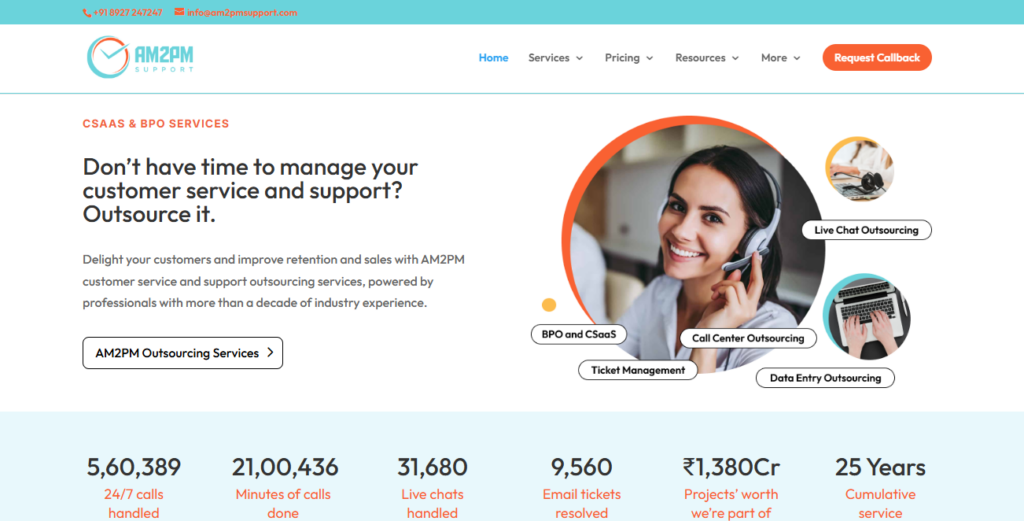
At AM2PM Support, we work with businesses that want reliable customer support without the time, expense, and day-to-day challenges of building a large in-house team.
From inbound customer service and outbound calling support to ecommerce customer care, live chat, and email support, we help businesses create support programs that fit their operations and budget.
Some clients need a dedicated team. Others need flexible coverage that can scale during busy seasons. We build solutions around those requirements instead of forcing businesses into one standard package.
If you are reviewing call center outsourcing pricing and want to understand which approach makes the most sense for your business, our team is happy to help.
Book your free call with AM2PM Support today to understand an outsourcing solution that supports both your customers and your growth plans.
Frequently asked questions about call center outsourcing costs
How much does call center outsourcing cost for a small business?
The total amount depends on your daily message volume, your service hours, and the channels you use to talk to buyers. Small businesses usually start with shared agent models or flexible monthly plans. These options keep your call center outsourcing costs low because you only pay for the exact time or resources you actually use.
How much does it cost to outsource customer service in 2026?
You will not find a single flat rate because every company has its own unique needs. Your final customer service outsourcing cost usually comes down to how many messages you get, the hours you stay online, the languages you need, and whether you pick dedicated or shared workers.
What is the cost of a call center outsourcing solution compared to hiring in-house staff?
In almost every scenario, outsourcing saves you much more money than building your own internal support desk from scratch. When you hire an in-house team, you have to pay for regular salaries, medical benefits, physical office space, expensive software licenses, training setups, and daily management. Outsourcing bundles all of these separate bills into one easy, predictable pricing model.
How do I calculate call center outsourcing costs for my business?
Start by counting your average monthly message numbers, the amount of time agents spend on a standard call, and the channels you use like phone or text. You also need to look at your daily operating hours and the number of workers you need online. These details are exactly what providers use to estimate call center expenses and suggest the best payment plan.
What is the difference between call center cost per call and call center cost per minute?
A call center cost per call setup charges you a single fixed fee every time an agent completes a conversation with a buyer. A call center cost per minute model bills you based on the exact amount of time workers spend actively assisting your customers. The better path simply depends on how long and how complex your typical customer issues are.
Are offshore call center pricing models really cheaper?
Yes, offshore call center pricing is generally much lower because the providers run their businesses in regions with smaller labor costs and cheaper rent. A lot of modern brands use these overseas teams to drop their overall customer service outsourcing costs while still keeping their quality high and opening up extra night or weekend hours.
What affects outbound call center pricing the most?
Outbound call center pricing is driven mostly by how complex your calling campaign is, the experience level of the agents, your overall lead numbers, and your performance targets. Sales programs and lead generation pushes usually require highly specialized agent training, which makes them cost more than simple inbound answering services.
What is included in call center services pricing?
Most standard call center services pricing wraps up the cost of agent wages, team supervisors, quality monitoring, data reports, software platforms, and day-to-day operations. Some companies also include the initial staff training and account setup directly inside their flat monthly fees.
Is a dedicated team worth the higher outsourced call center cost?
For fast-growing businesses, the investment usually pays off. Dedicated agents spend all their time focused on your brand, so they build a much deeper understanding of your products, workflows, and users. Even though the initial outsourced call center cost sits a bit higher, you get much stronger customer satisfaction and more consistent service quality.
How much does it cost to hire a call center for ecommerce customer support?
Online stores support pricing changes based on your monthly order numbers, the volume of user questions, your chat channels, and seasonal spikes. Brands that see massive traffic floods during the holidays or special sales events usually pick highly scalable outsourcing plans that let them add or remove workers instantly as demand shifts.
