
I was on a call last month with a founder of a mid-size SaaS company who said something I’ve heard at least a dozen times this year:
“We just can’t keep up with support anymore. We’re hiring, but training takes forever. Our ops lead is answering tickets at night. It’s becoming a mess.”
If that sounds familiar, you’re not alone. Whether you’re a founder, operations head, or team lead trying to keep customers happy while your team is drowning in tickets, this guide is for you.
In 2026, outsourcing your contact centre doesn’t have to feel like giving up control or sacrificing quality. It’s about working smarter.
Let’s break it down in plain terms with any buzzwords.
What is contact centre outsourcing?
Outsourcing your contact centre means letting an external team handle your 24/7 customer service for calls, emails, live chat, or even social DMs on your behalf.
You choose how much to outsource. It could be:
- Weekend support
- Call center outsourcing
- Live chat outsourcing
- Or full 24/7 service across all channels
There are a few models:
- Onshore: Same country, more expensive but easier on time zones and tone
- Nearshore: Neighboring countries with cultural and language fit
- Offshore: Often the most cost-effective, but needs more training upfront
The main point?
You don’t have to hire a full customer service team just to keep customers happy. You can bring in help only where it’s needed.
Why more companies are outsourcing now

Let me tell you that outsourcing isn’t something new. It’s been happening for centuries.
Take manufacturing, for example. In the 1800s, textile companies in England started outsourcing parts of their production to smaller mills to save time and reduce costs. They didn’t call it “outsourcing” back then, but that’s exactly what it was, handing over certain tasks to others so they could focus on what they did best.
Fast forward to today, and businesses are doing the same thing, just in a different way. Instead of fabric or machinery, we’re outsourcing things like customer service, marketing, IT BPO services, and operations. The goal is still the same: work smarter, not harder.
So why are more businesses outsourcing customer support specifically in 2026?
Let’s break it down in plain terms:
To keep costs manageable

Hiring full-time support staff is expensive. Because you’ve to take care of their salaries, benefits, training, time off, and more. And for a growing business, that kind of fixed cost can be really hard to manage.
Here outsourcing gives you more flexibility:
- You pay for what you actually need, nothing more.
- You skip the hassle (and expense) of hiring and onboarding.
- You keep your overhead low, especially if you’re scaling.
Related: Expert Guide to Customer Service Outsourcing Cost in 2026
To free up internal time

If your team is spending hours each week dealing with customer tickets, refund requests, or follow-ups, you’re not alone.
A lot of founders and operations leads fall into that trap. It’s not that the work isn’t important, it is. But it’s not always the best use of your time.
Outsourcing contact centre lets you and your team:
- Focus on strategy, growth, and higher-level tasks
- Stop playing catch-up in the inbox
- Finally step out of reactive mode
To scale without hiring headaches

Let’s say you’re gearing up for a product launch. Or maybe your business just hit a growth spurt and support volume doubled overnight.
Hiring more people takes time. Training takes even longer.
Outsourcing gives you breathing room:
- You can ramp up fast with a trained team
- You don’t need to commit to long-term contracts
- You can adjust as your needs change like seasonal spikes, new markets, etc.
The above are some solid reasons why more and more businesses are choosing contact centre outsourcing. It helps you scale, saves money, and gives your internal team room to breathe.
But here’s the other side of the coin.
Outsourcing isn’t a silver spoon or a one-click solution. If you don’t have your house (business operations or internal systems) in order, things can fall apart. You need clear processes, proper documentation, and someone who can manage the relationship day to day. Without these, it can get messy fast.
That said, when it’s done right, it works. With the right partner and clear expectations, outsourcing is one of the smartest ways to keep your support running smoothly. It helps you avoid burnout and keeps your costs under control.
Contact centre outsourcing trends you should know about

Not long ago, I had a call with the operations head of a mid-sized D2C brand based in Mumbai. They’d just wrapped up their biggest sale season.
Orders were booming, traffic had doubled, and their customer support inbox?
Overflowing.
He told me something I still think about:
“Sales were great, but I barely got any sleep. I was replying to customer queries on Sunday mornings. My team was exhausted. We knew this wasn’t going to work long-term.”
During the conversation I asked him, “Why not consider outsourcing?”
He paused for a while, then shared something that I hear from a lot of business owners:
???? “What if it feels robotic?”
???? “Will our customers even know they’re talking to someone else?”
???? “How do we make sure they sound like us?”
Totally fair questions.
So instead of outsourcing everything at once, they started small. Just weekend live chat support to boost sales, handled by a team sitting in Delhi.
In two weeks, they noticed:
- Faster response times
- Less pressure on their in-house team
- No complaints or drop in customer satisfaction
That small experiment gave them confidence. They didn’t go all-in right away, they took a strategic approach.
And that’s the key: strategic.
Outsourcing in 2026 isn’t about handing over everything. It’s about building a setup that supports your business, without losing the personal customer service touch your customers expect.
Here’s what’s actually working for Indian businesses right now:
AI is helping, but it’s not replacing humans
Most outsourcing partners today offer AI tools to reduce customer complaints and handle basic customer queries like tracking orders, FAQs, or sending invoice copies. It’s useful, no doubt. But it’s not enough.
In real life, Indian customers still prefer talking to a person when things go wrong like late deliveries, complaints, refunds, or anything emotional.
So what actually works is a hybrid model:
- AI handles common questions
- Human agents take over when empathy, clarity, or decision-making is needed
Getting tired of missing after work hour inquiries?
Improve your customer service game with AM2PM Support contact centre services.
Start small: Micro-outsourcing is the new default
You’ve probably heard this before: Think big, start small.
That applies perfectly to outsourcing in 2026.
Most Indian founders and ops heads don’t jump into full-scale outsourcing. What’s more common is partial or selective outsourcing, like:
- Handing off only Tier 1 support (basic queries like order status or refund tracking)
- Getting help during weekends or peak hours
- Using external teams for just one channel (e.g., WhatsApp or voice calls)
This approach lets you test the waters, keep control, and reduce risk.
A D2C electronics brand in Bangalore started an out of hours live chat outsourcing service. It gave their internal team a break, without affecting the customer experience.
Metro-based outsourcing teams are getting smarter and more specialized
There was a time when outsourcing meant big call centers companies with rows of agents reading from scripts. That model still exists, but it’s changing fast, especially in tier-1 cities like Delhi, Mumbai, and Bangalore.
Today, many businesses prefer working with medium, more focused teams based in metro hubs who:
- Understand regional markets
- Offer support in multiple Indian languages
- Are trained in both empathy and tech tools (like CRMs, chat platforms, etc.)
Support isn’t just about speed anymore: Today quality counts more than ever
Today’s Indian customers don’t hold back. Whether you’re selling software, delivering groceries, or running a D2C brand, customers expect fast, helpful, and respectful support, and they’re not shy about leaving reviews when they don’t get it.
That’s why quality matters just as much as speed and good outsourcing partners (especially in tier-1 cities like Delhi) know this well.
The best teams don’t just handle more tickets. They improve actual CX (customer experience) by tracking:
- Response time: How quickly are you replying?
- Resolution rate: Are issues getting solved the first time?
- CSAT (Customer Satisfaction Score): Are people happy with the support?
“One bad support experience can hurt your Play Store/Google ratings or trigger a Twitter rant. And that costs more than any monthly fee.”
So, instead of just asking “What’s your rate per seat?”, ask:
???? “How do you measure service quality?”
???? “Will I get weekly or monthly reports?”
???? “How do you train your team to handle my tone and brand?”
A good partner won’t just say “yes”, they’ll show you how.
Common concerns about outsourcing (addressed honestly)

If you’re considering outsourcing your customer support, you probably have a few doubts. That’s normal, especially if you’ve never done it before.
Here are the most common concerns we hear from Indian business owners and managers, along with what’s actually true (and what’s just myth):
❓ “Will it feel robotic to my customers?”
It depends on how you do it.
If you hand off support without any training or guidelines, yes, it can feel cold and scripted. But if you work with the right partner and give them clear instructions (your tone, your style, your common replies), most customers won’t notice the difference.
Let me share a simple fix that you can try:
Share your FAQ list, create a tone-of-voice guide, and review some sample chats before going live. It takes a little time upfront, but it makes a big difference.
❓ “Will my customers know it’s outsourced?”
Maybe. But that’s not necessarily a bad thing.
Many Indian businesses are upfront: “You’re speaking with our support partner.” Others don’t mention it at all. The key is not whether it’s outsourced, it’s whether the service is fast, helpful, and respectful.
Also, If the experience is good, customers rarely care who answered, just that they were taken care of.
Concerned about rising contact center costs?
Improve your customer service game with AM2PM Support contact centre services.
❓ “Can they handle Hindi or regional languages?”
Yes and this is where choosing an Indian partner makes a big difference.
Most domestic outsourcing teams can handle support in English, Hindi, and sometimes even Bengali, Tamil, Telugu, or Marathi, especially if you work with teams where multilingual talent is common.
❓ “Is my customer data safe?”
A valid concern, especially with rising data privacy regulations.
The best outsourcing companies will:
- Sign NDAs
- Limit access to sensitive data
- Work within secure systems (like Freshdesk, Zoho, or Intercom)
- Offer role-based access controls
To get more surety: Always ask what data protection protocols they follow. And make sure you set boundaries on what agents can see and do.
❓ “Is outsourcing only for big companies?”
Not at all. That might’ve been true a few years ago, but not anymore.
These days, it’s actually the smaller and mid-sized Indian businesses that are outsourcing more. Why? Because they don’t always have the time, money, or headcount to build a full in-house support team.
You don’t need a huge budget or hundreds of tickets per day. Even if you’re getting 70–100 chats daily, outsourcing part of that load like just night shifts or handing inbound calls can take real pressure off your team.
How to choose the right contact centre outsourcing partner in 2026

That’s the thing with outsourcing. It’s not just about whether you do it, it’s about how and who you do it with.
Plenty of Indian businesses have tried outsourcing and dropped it within months.
No not because the idea was wrong, but because the partner was.
One bad experience can leave you thinking, “We’re better off doing it ourselves.”
But with the right team like AM2PM Support, outsourcing doesn’t feel like outsourcing. It feels like you just added a solid extension to your own setup, without the hiring headache.
So before you dive in, take a step back and ask the right questions.
Here’s a simple checklist to help you make a smart, low-risk choice:
✅ Start by knowing what you actually need
Before you even talk to an outsourcing company, be clear on your own side:
- Are you looking for 24/7 support? Or just evenings/weekends?
- Do you want full coverage or just help with Tier 1 questions (order status, returns, password resets)?
- Do you need multilingual support (English + Hindi, or regional languages)?
Tip: Write down your top 3 problems. Let that guide what you’re asking for, not what the provider is selling.
???? Ask the right questions (don’t just talk price)
A lot of companies jump into outsourcing based on the cheapest quote. But price alone doesn’t tell you how good the service will be.
Here are the questions that matter:
- What tools do you use (Freshdesk, Zoho, Intercom, etc.)?
- Can I listen to sample calls or read chat transcripts?
- How do you train agents on our tone and process?
- Do you offer a pilot or trial period?
- How will you report performance (response time, resolution rate, CSAT)?
Deliver your customers a personalized support!
Hire AM2PM Support contact centre outsourcing services.
???? Choose based on fit, not just location
Some businesses assume they need a local team. Others look only at price and go straight to the cheapest offshore option. But in reality, it’s less about where your partner is based and more about how well they align with your business.
If your customers are in India, working with a team that understands the local context, language, expectations, urgency, makes a big difference, whether they’re based in a Tier-1 city or a smaller one.
Wherever the team is based, ask yourself:
- Can they handle your customer base’s language and tone?
- Are their working hours aligned with your business?
- Do they actually understand your industry and customer expectations?
Note: Our team at AM2PM Support is based in a Tier-1 city (Delhi), but we serve clients across India and globally. What matters more than location is having a setup that’s reliable, scalable, and easy to work with.
???? Ask how they track and share results
A professional team will track performance and share those numbers with you without you chasing.
Make sure they can show you:
- Response times
- Resolution rates
- Customer satisfaction (CSAT) scores
And yes, insist on regular reporting (weekly or monthly), not vague “we’re doing well” updates.
???? Start Small, but think long-term
You don’t need to commit to a massive retainer or yearly contract.
Just ask for:
- A 30–60 day pilot
- Flexible scaling (add/remove agents based on volume)
- Clear SLAs (service level agreements) in writing
Because a good outsourcing relationship should earn your trust, not demand it up front.
To sum this up, choose a team that gets your business, communicates clearly, works with transparency, and is willing to start small and grow with you.
Case studies

As mentioned above, “outsourcing isn’t a silver spoon.”
But for many Indian businesses, it’s helped solve real operational issues, from agent churn to weekend support gaps in a way that’s scalable and sustainable.
Here are some examples from companies we’ve worked with, showing what outsourcing actually looked like for them.
EEZYLIFE: Managing team fluctuations without the hiring hassle
EEZYLIFE is a company that supports e-commerce sellers with BI tools and backend solutions. Their main challenge? Fluctuating volumes and repeated training needs. Every time sales picked up, they had to rush-hire. Then during slow periods, those same hires became overhead.
They started by outsourcing cold calling on weekends only. No big contract, just enough to test. Over five months, they saw:
- A steady increase in booked meetings through cold calling
- More stable performance from outsourced agents
- No need to constantly rehire and retrain in-house staff
They didn’t outsource everything, just the parts that were breaking their internal system. It worked.
The Artment: Getting a handle on abandoned carts and 7-day support
The Artment sells high-end home décor and furniture. They were missing leads through abandoned carts and had no weekend support. They didn’t want a massive call center, just help where it counted.
Here’s what we did:
- Assigned a dedicated inbound agent for 7-day coverage
- Added shared agents specifically for abandoned cart follow-ups
In 3 months:
- Revenue from abandoned cart calls went up 40%
- Chat response time dropped to 2.5 minutes
- They reduced overall support costs by nearly 40%, since they weren’t hiring full-time in-house
Sometimes, you don’t need more people. You just need the right setup.
University Living: Handling seasonal volume without overcommitting
University Living helps students find housing across cities like Toronto, London, and Sydney. Their team struggled to keep up with global leads, especially during university admission seasons.
Their biggest challenge was scaling support up and down without hiring full-time teams. They also needed pre-sales calling and instant response on inquiries.
They outsourced only lead qualification calls, nothing more.
In 3 months:
- Sales increased by 30% through better lead handling
- No leads went cold, thanks to faster callback turnaround
- The internal team focused more on conversions, less on first-touch queries
For them, outsourcing wasn’t about saving money, it was about saving momentum.
Flo Mattress: Reducing refunds and improving call quality
Flo Mattress runs a high-volume e-commerce business. Their challenge? Supporting customers round-the-clock, especially during weekends and holidays, without bloating headcount.
Their outsourcing goals were simple:
- Reduce refunds and returns
- Cover off-hours and peak seasons
- Improve call quality checks, which were limited to just 5% of calls earlier
Here’s what changed in 6 months:
- Order returns dropped 12–15%, thanks to faster support
- 100% of calls were audited, up from just 5%, using AI-assisted QA
- Call pickup time improved to 8–10 seconds
- They cut hiring and training costs by 35%
The biggest win? Senior managers didn’t have to jump into customer calls anymore, freeing them up for actual strategy work.
These are not big bang stories. They’re some practical examples of outsourcing done one piece at a time where the company stayed in control and solved the right problems first.
Tips if you’re getting started
1/ Start small. Don’t jump into a 12-month contract. Test one channel first.
2/ Write your FAQs. Create a shared doc with responses to common questions.
3/ Treat them like a real team. Weekly check-ins > fire-and-forget.
4/ Track your KPIs. Look at response time, resolution rate, and CSAT. If it’s not improving, something’s off.
So… is contact centre outsourcing the right move for your business?
It depends on where you are right now.
Maybe your internal team is already stretched. Maybe you’re getting more support tickets than you can respond to in time. Or maybe you’re growing, but hiring and training just isn’t keeping up.
Outsourcing isn’t the answer to everything. But for a lot of businesses we work with, it has helped take pressure off the internal team without compromising customer experience.
The best results usually come from starting small. A few hours of weekend coverage. One dedicated agent for follow-up calls. Shared resources to handle seasonal peaks. That’s how most of our clients begin. No big commitments. Just solving one clear problem at a time.
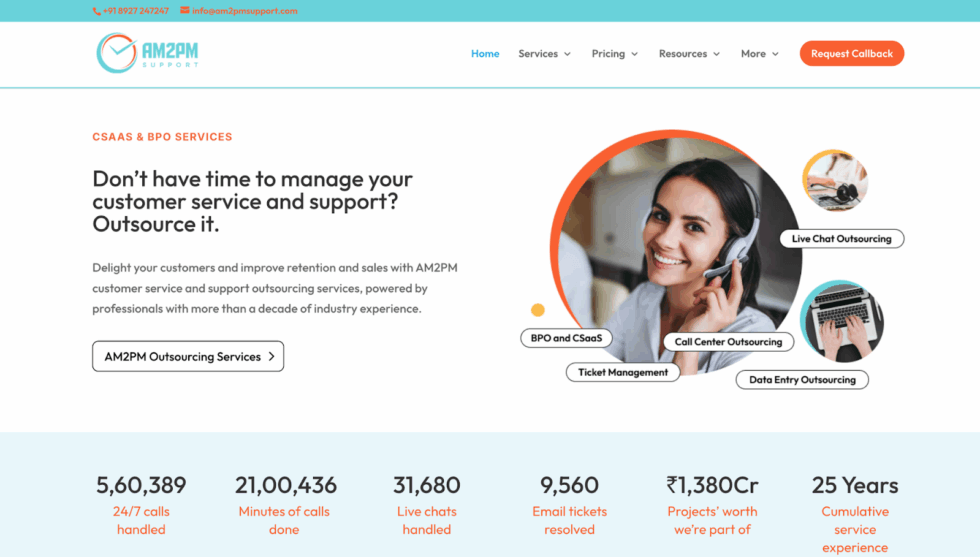
At AM2PM Support, we’ve worked with startups, D2C brands, growing SaaS companies, and more industries across India. Some come to us for abandoned cart recovery. Some need better chat response times. Others just want someone they can rely on when the volume gets heavy.
We don’t promise “overnight growth” or “magic support.” What we do promise is consistency, flexibility, and a team that works like an extension of yours.
If that sounds like something you’re open to exploring, we’re happy to have a simple conversation.
???? Book a free consultation with AM2PM Support. Just a quick call to see if we can actually help.